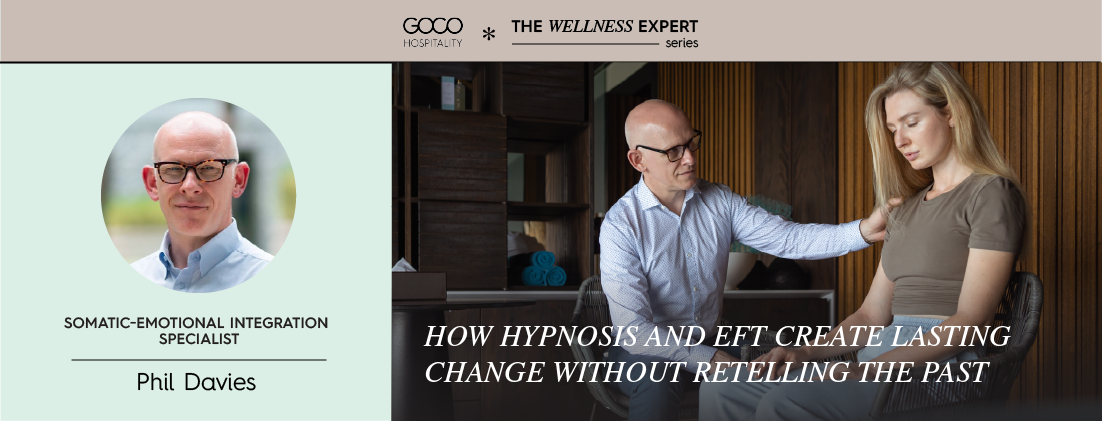
GOCO Wellness Experts Series with Phil Davies
How Hypnosis and EFT Create Lasting Change Without Retelling the Past
While traditional talk therapy often centres on revisiting emotional pain to understand and resolve it, modalities like Clinical Hypnosis and Emotional Freedom Techniques (EFT) offer a different path, where clients do not need to relive or even verbalise their trauma to experience deep healing. In this interview with Phil Davies, a somatic-emotional integration specialist, we explore how content-free therapy can support profound transformation in a single session, offering a powerful, safe alternative for those who value privacy, emotional safety and efficient results.
Drawing from over 20 years of experience in vibrational attunement, hypnotherapy, EFT and past-life regression, Phil’s holistic work has supported thousands of people through trauma, addiction, anxiety, PTSD and more, with many reporting significant change after just one session.

Phil Davies
Q1. Many people associate therapy with talking, sharing, explaining and analysing. But in your experience, healing can happen without verbalising the story. Can you explain how “content-free” therapy works, and why it can be so powerful for certain individuals?
Content-free sessions allow individuals to release trauma without the need to retell or relive their story, which can be particularly liberating for those who feel guarded. With EFT, for example, we might explore how an emotion is experienced in the body its colour, shape, sound, or texture and use tapping to reduce its intensity. In hypnosis, we can use methods such as A.D.A.C. (Activate the memory, Dissociate from the event, Associate with a stronger state, Collapse the original state), the Rewind Pattern (running a memory forward and backward in a dissociated state to neutralise the emotional charge), or Mirroring Hands (externalising the problem in one hand and a solution in the other). We can also work directly with the unconscious or with the ‘injured part of self,’ integrating it with new resources to restore balance and healing.

Phil Davies – Hypnotherapy
Q2. Your clients often report breakthrough moments within a single session. What makes modalities like Clinical Hypnosis and EFT so effective at creating measurable change in such a short amount of time?
These approaches are so effective because they connect directly with the part of a person that holds the unresolved emotion. By identifying where and how the emotion is felt whether in the body, in a memory, or in anticipation of a future event, we bring that part into awareness. From there, we can shift and re-pattern the response in real time, checking throughout the session until the emotional intensity reduces. This direct connection often leads to breakthrough moments, even in a single session.
Q3. For clients who may have experienced trauma or who feel emotionally guarded, how do you create an atmosphere of trust, safety and readiness for deep healing, even when little is said out loud?
Trust and safety are the foundation of this work. My initial sessions are always longer, so there is sufficient time to build rapport, clearly explain the process, and answer any concerns they may have. Sitting fully present with compassion, without judgment or urgency, creates an environment where clients feel at ease. Attention to subtle details from the seating arrangement to the overall space, is designed to support comfort and readiness for change. By the time they are with me, most people already know that something needs to change. What they often discover in those first moments is that change can begin more gently and safely than they imagined.

Phil Davies – Vibrational Attunement
Q4. Can you share a (confidential) example of a case where someone experienced significant change through content-free work, perhaps without even telling you the full story of their challenge?
There are many cases where clients have experienced profound change without ever needing to tell me the full story. In one instance, a guest couldn’t even bring herself to assign a word to her challenge. Instead, we worked directly with how the emotion was showing up in her body. Using EFT, we agreed on a simple substitute, “mmm mmm mmm” as the phrase she could use in place of the unspeakable word. Her set-up statement became: “Even though I have this mmm mmm mmm, I’m open to loving and accepting myself.”
From there, we tapped while focusing on the sensory markers of the experience: “this mmm mmm mmm,” or “this red, spiky, screaming anger in my throat that smells like sewers and tastes like blood.” These previously established visual, auditory, and kinesthetic (VAK) markers gave us a way to engage with the memory without needing to talk about it in detail.
Within just three rounds of tapping, her emotional intensity dropped from a 10 to a 4. At that point, she told me she felt safe and wanted to share, for the first time, that she had experienced childhood sexual abuse. There had been no expectation for her to do so; the decision arose naturally once the intensity eased. By the end of the session, the charge around the memory had reduced to zero, which we confirmed through gentle testing.
A few days later, she contacted me to say her entire outlook had shifted. She recognised how the past had led her into a cycle of abusive relationships, and she decided that more things had to change. Shortly afterwards, she left her marriage, changed cities, began a new career, met a supportive partner, and went on to build a happy family life.
I offered this particular example as it also highlights that “content-free” does not necessarily mean passive or silent. The client still actively participated by naming the emotions, noticing how they were in the body, and using symbolic substitutes while being spared the need to retell their story.
In another case, the guest faced two challenges: not only was the emotional distress crippling, but they were also high profile and, despite reassurance, deeply concerned about privacy. The client was aware of three specific events they believed were responsible, and I asked them to rate the emotional intensity of each. Interestingly, although the most recent event carried the strongest charge, it was the earliest memory, often the initial sensitising event, that was the true root.
Before proceeding, we established what their preferred state would be, and I noted moments from their life where they had felt most powerful, confident, and in control. We had agreed to use hypnosis for this session, and once the guest was in a deep working trance, we utilised a version of the Rewind Technique. First, they imagined watching themselves, watching the movie of the event, not reliving it, just observing themself from a distance. Then, at the end of the movie, they stepped into the screen, experiencing it running at high speed in reverse.
As we repeated this sequence, the charge of that first event dissolved, and without needing to address the others directly, the intensity of the remaining two events collapsed as well. This is often what happens when we work at the true root. With the distress gone, I anchored their new powerful state in place of the old memory.
At the close of the session, the guest mentioned a video that had always triggered a strong emotional reaction, and asked if they could test it. As they watched, their posture and breath immediately shifted into that of power and confidence. A response that, in our last conversation, they told me has remained with them to this day.

EFT
Q5. You work with a wide range of issues, from addiction and anxiety to PTSD and weight challenges. Are there certain patterns or root causes that show up across these conditions? How does your work address them?
Although these conditions may appear very differently on the surface, there is almost always a traumatised or injured part of the self at the root. In the case of addiction, for example, a substance or behaviour is often used to sedate that part, numbing it so the person doesn’t have to feel the underlying emotion.
With weight challenges, the same pattern can apply, where food may have become a way of soothing, protecting, or even creating a physical barrier between the self and the outside world. When we address the underlying emotion and bring that part of the self into balance, the need for the old coping strategy reduces.
My work begins with identifying and healing that core wound or trauma. Once the intensity of that injured part has been resolved, we can then redirect behaviours and address any habits that have formed around it. This way, change doesn’t just come from willpower, it arises naturally because the original driver has been released.
Q6. If someone is considering a session but is unsure about whether they’re “ready” to face their past, what would you say to reassure or guide them?
It’s completely natural to feel uncertain about whether you’re ready. After explaining the process and answering any fears, I often invite them to imagine how life might look like if they had already let go. How different would things feel for them, and for their family, without the weight of fear, anger, or pain? How much better would life be if they were free, compared to how it feels now?
Often, that simple reflection helps people see not just what they might leave behind, but also what they would stand to gain.
For more details about Phil Davies, please visit https://phil-davies.com/