Wellness Expert Series
The wellness treatment beds and technologies behind the guest experience: a conversation with Sammy Gharieni
This month, we conversed with Wellness Industry Pioneer, Sammy Gharieni, known for his visionary industry leadership and his pioneering spirit. He has built an extraordinary Wellness brand based on a DNA of innovation. He began by revolutionising the sector of treatment beds 35 years ago, when he founded the Gharieni Group, realising there were important gaps in the market that could be turned into singular opportunities. Today, the Gharieni Group has a 140-country reach and is the leading company and thought leader in the area of spa, wellness, and medical treatment beds, and Mind/Body Wellness Technologies. Under its wings, the Gharieni Group now encompasses four brands: its legacy brand Gharieni, Mind/Body Wellness Technologies brand Metawell, Bentlon, bringing a fresh approach to business ownership with vibrant, engaging branding, and Cobotics Innovations, a new generation of wellness robotics.
Sammy is the recipient of the coveted ´A Life of Beauty Award’ from industry event, Beauty Düsseldorf, and ‘A lifetime Achievement Award’ from Australia’s renowned Elly Lukas Beauty Therapy College. His unique perspective, having been raised between Belgium and Tunisia, together with an engineering degree in Germany, fuels his passion for driving innovation. He continues to travel the globe to find inspiration and new ideas to create new business opportunities and improve existing processes. His customer-centric mindset is always looking to improve service, curate experiences, and refine processes that will deliver exceptional value and support his customers’ businesses – while delighting the consumer with unique Wellness experiences.
At GOCO, we are no strangers to Gharieni and Metawell wellness equipment and, in fact, have on several occasions recommended their wellness treatment beds across the many spa and wellness concepts we conceptualise for hospitality brands worldwide. And with good reason, the exceptional engineering and craftsmanship, the uncompromising luxury positioning, and the advanced wellness technology that consistently elevates both the guest and therapist experience make them a natural fit for the calibre of projects we stand behind.
In this edition of our Wellness Expert Series, we go beyond the portfolio. We asked Sammy the questions we know many wellness curators, operators, investors, and hospitality leaders may be asking themselves, and hope the answers bring the insights needed to navigate one of the industry’s most important decisions when it comes to wellness technology and equipment.
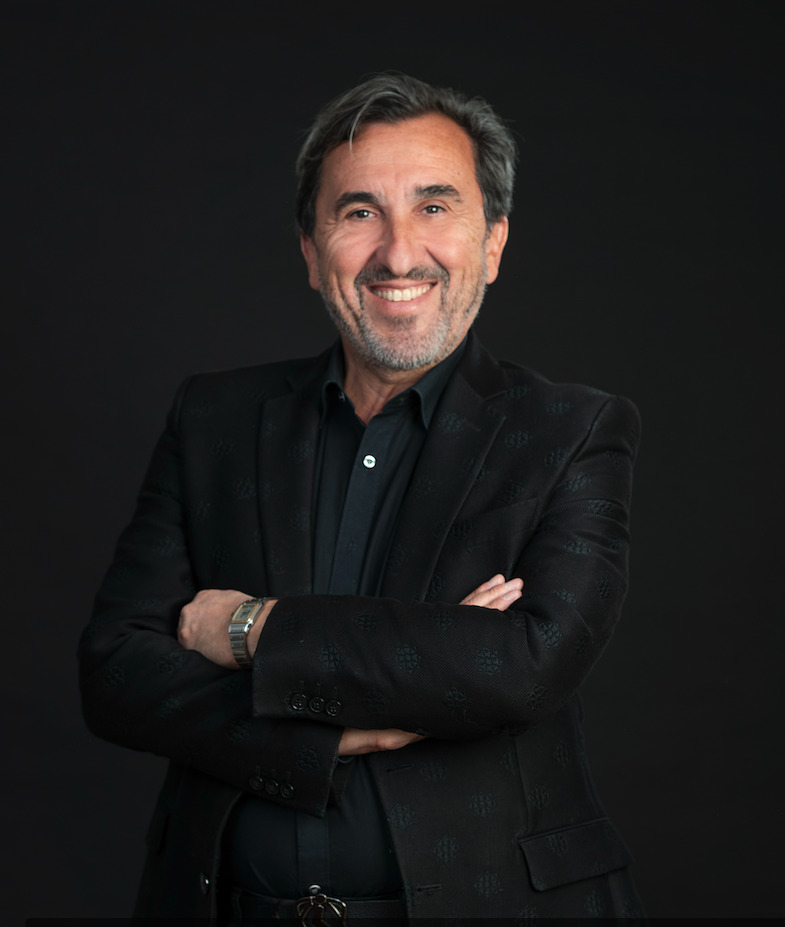 Sammy Gharieni, Founder of The Gharieni Group
The wellness equipment world has exploded with cold plunge, infrared, compression therapy, recovery tech. From where you sit, what is actually backed by real evidence, and what is riding a trend wave that might not last?
There’s a lot of noise in wellness right now, and I think we need to broaden what we mean by “real evidence.”
Today, references to science are everywhere, often without much substance once you look beneath the surface. Both operators and guests are becoming much more discerning about that.
When we developed our first vibroacoustic treatment bed, 15 years ago, very few people were talking about wellness tech. Today, the market has exploded. That made me more curious to understand whether our own technology was actually making a measurable difference, which is why we chose to invest in studies rather than simply rely on claims.
Still, science is only one piece of the puzzle. People ultimately return if they enjoy what they do. It sounds simple, but a compelling guest experience continues to hold its ground. For me, it comes down to three things: does it produce measurable outcomes for the guest, does the guest genuinely value the experience, and can it be integrated into a business model in a sustainable, commercially viable way? If one of those is missing, I would question its long-term value.
Finally, operators shouldn’t chase every new trend or reinvent themselves around whatever is fashionable. You don’t need to become a longevity clinic simply because longevity is having its moment. Start with what you already do well and ask which proven elements can genuinely enhance it for your guests and your business. That’s the difference between following a trend and investing in something with real staying power.
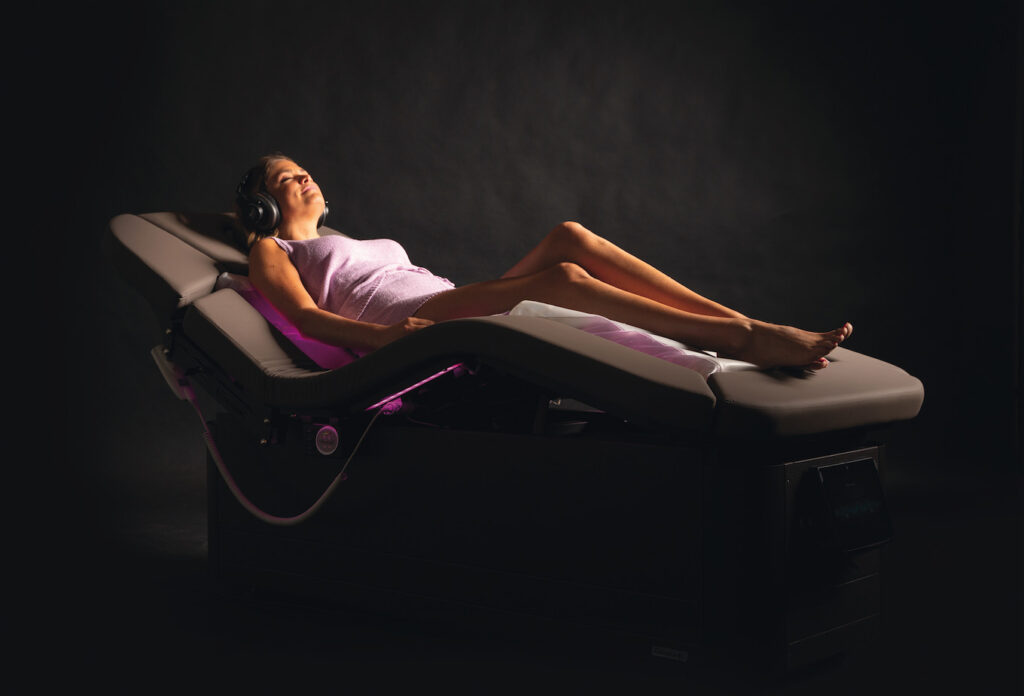 Gharieni Welnamis sound and vibrational technology
You operate between “medical device” and “wellness equipment.” How do you decide where a product belongs, especially as regulations and guest expectations keep shifting?
It’s actually quite simple for us: we are a wellness company, not a medical device company, and we are clear about that distinction.
For every technology, we are deliberate about how it is positioned and what we say it can do. We know the boundaries of each product and stay within them, rather than stretching claims.
Where a product is intended and certified for medical use, the requirements are naturally much more rigorous. For example, the reLounge ZeroG is medically approved, and we also have treatment beds certified for medical use. These products undergo the necessary studies, testing and regulatory processes before they can be marketed as medical devices or equipment.
Regulations and guest expectations will continue to evolve, but I don’t think the fundamental approach needs to change. Be clear about what a product is, respect the regulatory framework it sits within, and never position it as something it isn’t.
For a hospitality brand bringing in wellness technologies for the first time, what separates a successful rollout from a failed one?
It comes down to how well you build the experience and integrate it into the business.
It has to become part of the concept, the guest journey and the team culture, otherwise even the best technology can become a very expensive piece of furniture.
I’ve visited properties where a significant investment has been made in a fantastic piece of equipment, only to find it sitting in the corner of an unused room under a blanket. It’s always sad to see, because the technology itself wasn’t the problem. There simply wasn’t enough thought given to what happens after it arrives.
That’s why our role doesn’t end after delivery. We work with our clients to train their teams, helping them understand not only how to use the technology, but how to introduce it to guests, talk confidently about its benefits and integrate it into the wider offering. If the team doesn’t understand or believe in it, the guest is unlikely to either.
We also developed proprietry ‘Metawell circuits’ that combine different experiences around specific guest needs and outcomes. It gives operators a framework for turning individual pieces of technology into a coherent guest journey, while still allowing them to adapt it to their own concept and clientele.
For an operator considering a major investment in your equipment, what should they realistically expect to pay back, and over what timeframe? What do people underestimate about the total cost (training, maintenance, staffing)?
Quality lasts. We’ve seen Gharieni treatment beds that have been in operation for 15 years or more, so when you look at the investment over its lifetime, that is important context. Technology is slightly different, but even there, the initial price can sometimes be misleading if you look at the cost without looking at the potential return.
There isn’t one payback period that applies to every operator, because treatment prices, utilisation and clientele vary enormously. That said, it’s not uncommon for clients to tell us that a technology has paid for itself within the first months of use when it has been integrated properly.
One client, for example, upgraded their spa with wellness technology and was able to increase the daily rate from $100 to $130 for an all-inclusive pass with elevated services. That translated to $1200 in additional revenue per day and approximatively half-a-million per year. So the business case can be very compelling.
Where I might challenge the question is around the assumption of significant additional costs for staffing. One of the advantages of wellness technology is that it generally doesn’t require additional personnel, it can help address staffing shortages and create additional capacity, which is a very real challenge in our industry today.
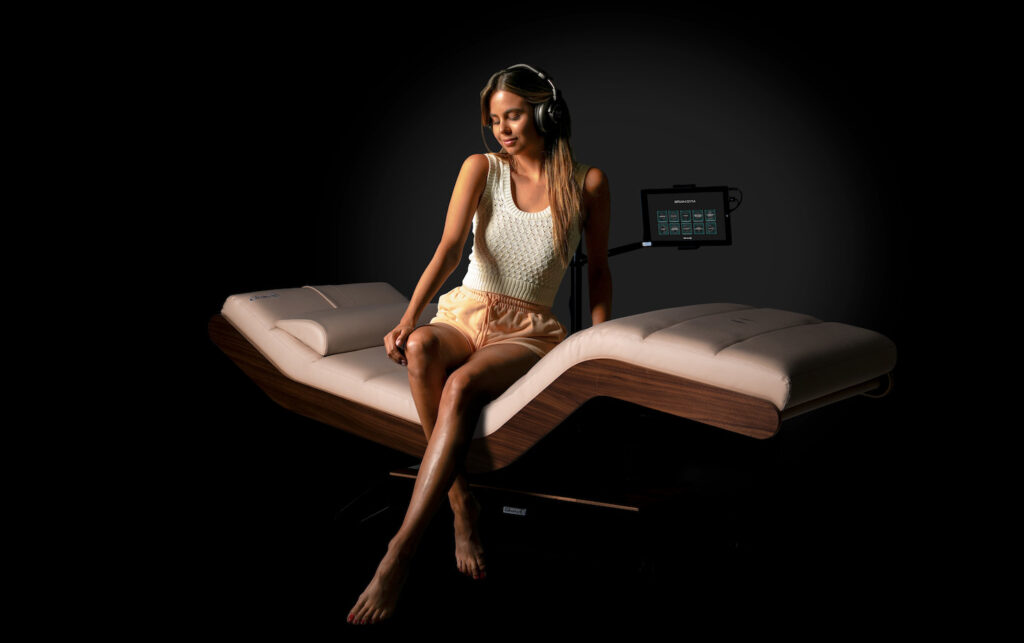 Metawell RLX BrainGym™, Mental Fitness Lounger
You also sell direct to consumers wanting this technology at home. Is that home-use trend feeding hospitality demand, or quietly competing with it?
I don’t really see the two as competing. It’s a different ball game. At the price point of our technologies, the private market is naturally concentrated among high-net-worth individuals, but what we are seeing in both residential and hospitality is part of the same much bigger shift: wellness is becoming integrated into how people live.
In hospitality particularly, wellness is no longer a separate amenity that begins and ends at the spa door. Guests increasingly expect it to be part of the entire stay, including how well they sleep, how they recover, how they eat, move and, ultimately, whether they leave feeling better than when they arrived.
We’re seeing the same thinking enter the residential world, with more private homes and residences being designed with wellness infrastructure from the outset. So I see home adoption as further evidence of how expectations are changing rather than as a threat to hospitality.
If anything, it raises the bar. As wellness becomes part of everyday life, hospitality has an opportunity to take it further by creating experiences, environments and combinations of technologies that guests simply wouldn’t have access to in the same way at home.
Is there something in your pipeline right now you are genuinely excited about that we haven’t seen yet?
It has to be our Wellness Cobot. And I’m very deliberate about calling it a cobot rather than another massage robot, because it was designed to work ‘with’ the therapist, not replace them.
This robot delivers percussion therapy, so it isn’t trying to replicate the therapist’s hands. Instead, it can take over a specific part of the treatment while the therapist focuses their expertise elsewhere.
The massage unit itself can also be easily moved to another room when needed, while the treatment bed remains available for other treatments. That creates interesting possibilities operationally: one guest could, for example, begin a treatment with the Cobot while the therapist is working hands-on with another guest. It allows operators to make better use of both their therapists and their treatment rooms, without compromising the human element.
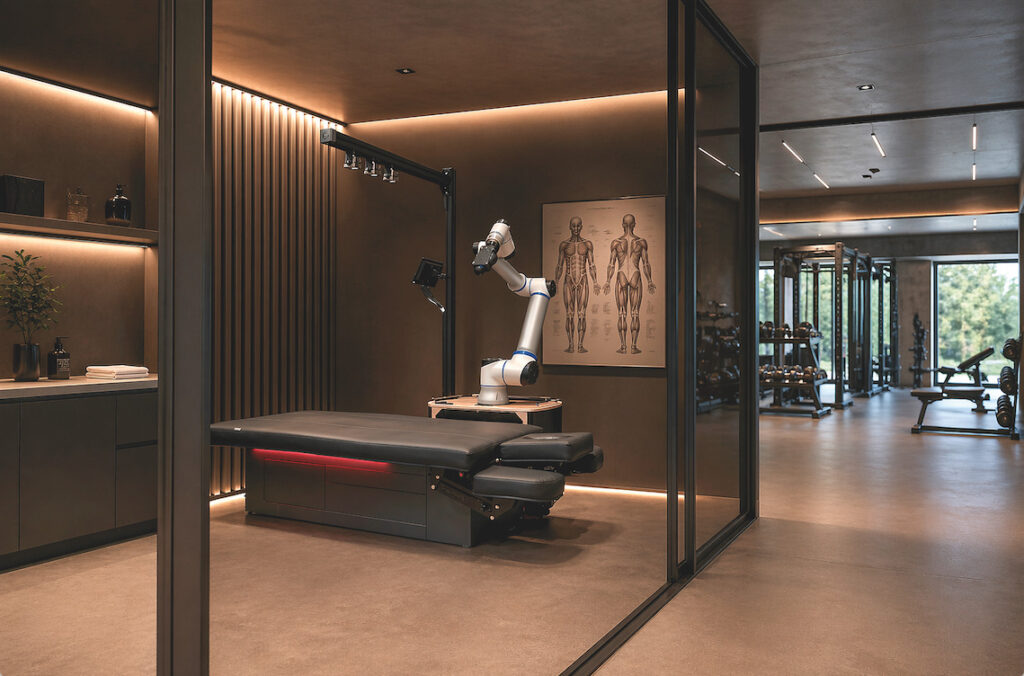 Gharieni Wellness Cobot
That’s where the future of technology in wellness becomes really interesting. It shouldn’t be about removing the human element; it should be about using technology where it adds value, while allowing the therapist to do what only a human can do.
For more information about Gharieni wellness products, please visit www.gharienigroup.com